
Exhibitions
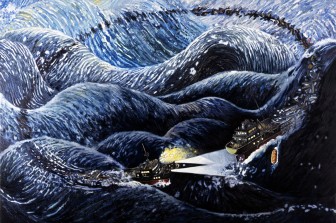
The Wave Effect - From a Japanese to Global Icon
The concept of this exhibition touches on the three elements that make up the Great Wave -- wave, boats, and Mount Fuji. These elements are represented here in the works of Japanese and Israeli artists and are translated into the language of the period in which they were created. The element of the wave is examined through works in which it is a stylized force of nature, an ethereal boundary line, a metaphor for social isolation, and a representation of existential anxiety; not necessarily anxiety related to natural disasters. The element of boats between the waves is associated with works about war in Japanese art and with works dealing with personal and national assimilation in Israeli art. The element of the mountain appears in traditional Japanese works that emphasize different perspectives of the mountain, alongside Israeli artworks which express the attraction to the mountain. The exhibition also gives space to young artists who respond to the work using diverse visual means and in defiant and different ways.
Saturday, 07.06.25
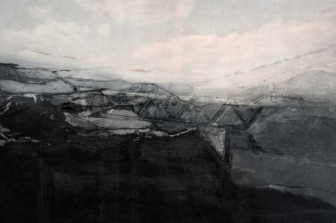
Lihie Talmor: From the Dark
The nuances, the different textures, the emanation of light or its concealment, what is highlighted and what is relegated to the shadows: in Lihie Talmor's works, every detail has a meaning and every action has a purpose. Her work is centered on a search for something that was lost, but left traces on site, despite the vicissitudes of time. The freedom inherent in printmaking enables reversal—transforming the documented into imaginary, and introducing tension between reproduction and fiction, between memory and invention. Through print, Talmor sheds light on dark chapters in the history of a place, uncovering truths and secrets hidden beneath the surface, and discussing the innate tensions between history, man, and place.
Saturday, 22.02.25
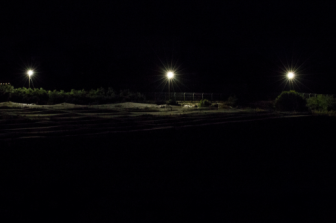
Hadar Saifan: Patrol
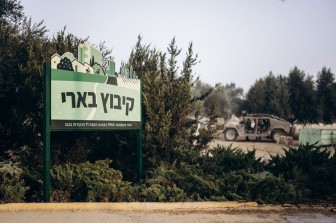
In her works, Hadar Saifan functions as a soldier: she spots aircraft, clears routes, patrols evacuated settlements, and shoots with her camera. The invasion of Israel in October 2023 reinforced the role of civilians in protecting their homes—people who felt they had been abandoned by the state and chose to fill the vacuum left by the official institutions themselves.
Saturday, 22.02.25
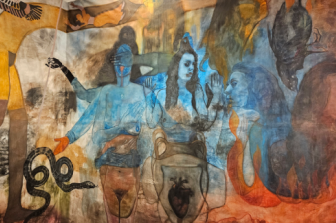
Merav Sudaey: Of Goddess Born
Merav Sudaey's exhibition space was transformed into a cave with painted walls, a ritual site for an ancient goddess. She draws inspiration from wall paintings in Hindu and Buddhist temples and monasteries, replacing all the figures with the image of one woman, her own. This painterly installation thus consists of a stratified series of self-portraits in which Sudaey examines her naked body as an object for painting while looking into herself as a subject. Applying diluted paint to the canvas, she heaps transparent layers one atop the other, which conceal or reveal spectral underlayers of female nudity. The two-dimensional canvas is rendered three-dimensional, as it were, as additional painterly worlds are waiting to be discovered under the top layer of paint.
Saturday, 22.02.25
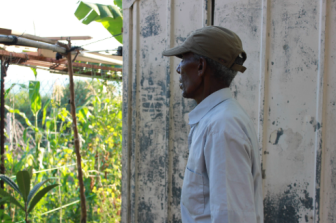
The Space For Community Art: Gevere Ribka | Belay
The works in the exhibition record male figures who have struggled for decades with an unabated will to adjust to a new place. Ribka chose to document them here, understanding that they have built a place that allows them to work at something they are good at, a place where they are able to create something new and reap the fruits of their success.
Saturday, 18.10.25
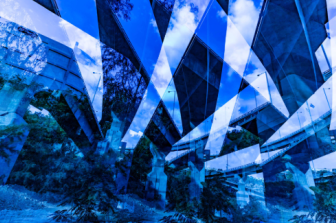
Through the Creek I Saw the World | Odin Shadmi
A dystopian vision appeared to Odin Shadmi's mind after working in the hi-tech industry. In her vision, our world is at a critical junction in time: progress, in which we've invested such a huge effort, overtakes us, leaving behind nothing but small traces of authentic nature. Following a dichotomous life experience, moving between the world of hi-tech and progress and a connection to nature, Shadmi decided to act.
Saturday, 14.09.24
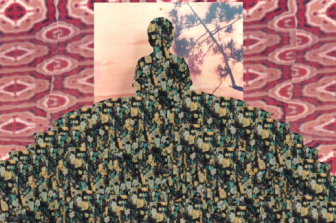
Space for Community Art: Rachel Anyo Figure Coming to Life
Rachel Anyo creates a new visual image of a feminist Ethiopian woman. She recruited 13 differently-aged women of Ethiopian origin for the project, and together they explored their culture by working in the collage technique. Based on a database of images prepared by Anyo from her family albums, the participants created collages under the guidance of the artist, who deconstructed and reconstructed them into new collages all her own.
Saturday, 22.02.25
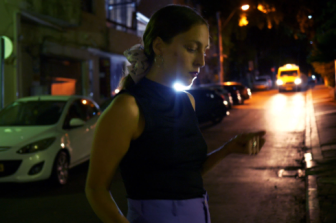
Space for Community Art: Liron Hana Ohayon & Amit Gavish 6+1
Equipped with white overalls, compassion and courage, Liron Hana Ohayon and Amit Gavish lead an interdisciplinary artistic act in the streets of Haifa. They gathered six women who recently moved to Haifa for a joint creative process, which included a confession and a statement of identity aimed at pushing the boundaries of involvement in the space. The six video works on view are elaborations of six acts of female healing, whose gist is coping together with personal passions and fears.
Saturday, 22.02.25
Northern Wind | Israeli Art from the Museum's Collection
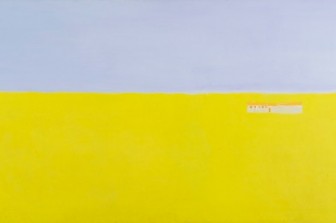
A north wind blows through the collection of Haifa Museum of Art. The museum’s location in the city of Haifa is reflected in its collection, which contains many works by artists based in Haifa and the north, attesting to Haifa’s unique identity: as a port city, the relation to immigrants and refugees repeatedly surfaces in the works; as a workers’ city, many of the works address class issues; and as a city nestled in a unique topography between the sea and the mountain, the works delve into interrelations between the earthly and the spiritual. From its focal point in the north, the collection also converses with Israel’s art centers, with Arab culture, and with Western modern art: turning south, to artistic practice in Tel Aviv and Jerusalem; east, beyond the Jordan Valley; and west, to what is happening overseas.
Saturday, 22.02.25
Please contact us and we will contact you as soon as possible