
Exhibitions
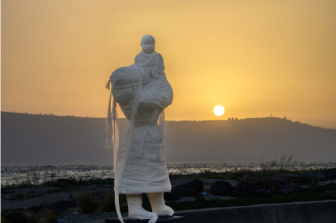
Crossing Lines – From Line to Thread
New Exhibition
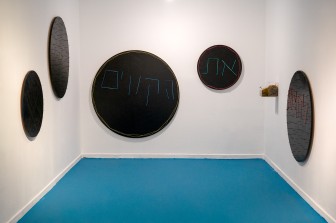
The common thread running through the exhibition is each artist’s special attraction to linear movement and its centrality in their works. Lines play an important role in all cultures, because they contribute to understanding, interpretation, and representation of reality. Humans, regardless of their affinity for art, consciously or unconsciously create lines. As walking and talking creatures who use hand gestures, humans create lines in space and time everywhere and continuously. A line can be material, like a thread, or immaterial – geometric or imaginary – like longitude and latitude lines and the horizon. A line can be a sequence of points, a product of thought, or an element associated with physical action, as in calligraphy and dance, for example.
Saturday, 02.01.27
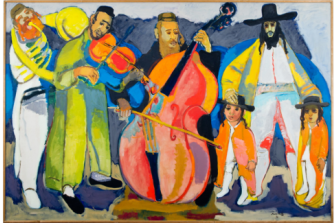
Mané-Katz: Music After the War
New Exhibition
This exhibition presents paintings and sculptures of klezmer musicians from the collection of the Mané-Katz Museum. The collection, numbering some 1,300 objects, is based on the artist's estate which he bequeathed to the city of Haifa, and which includes approximately 180 oil paintings. These works had not been exhibited for many years and have undergone extensive restoration, including cleaning, paint consolidation, and replacing of stretchers, thanks to the generous support of the Schusterman Foundation Israel.
Saturday, 02.01.27
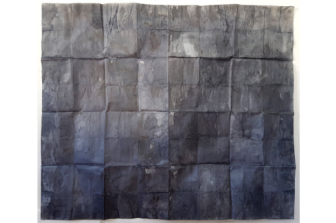
Eti Levi: Ascent
New Exhibition
Eti Levi's (b. 1981, Jerusalem) works emerge from an encounter with ancient textual sources and a desire to draw closer to the Hebrew language in its primal state. In the Bible and in Jewish mystical texts, "ascent" is associated with visions and experiences of both physical and spiritual transcendence. The exhibition space functions as a transitional realm, linking physical movement with shifts in consciousness. Levi regards artistic practice as a meditative act and a physical channel of expression that bypasses rational thought, allowing impressions and sensations to be embraced in their raw form.
Saturday, 02.01.27
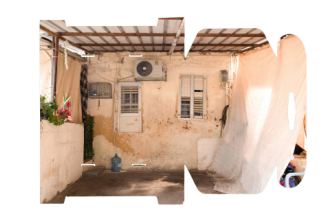
Lian Sharkia: Teta
New Exhibition
The exhibition forms a chapter in Lian Sharkia's (b. 2000, Jatt, the "Triangle" area) journey into her grandmother's past. Born in Haifa in 1946, Samia left for the village of Jatt at the age of nineteen following her marriage. The works on view offer a glimpse into her memories and stories, reflected and reconstructed through the eyes of her granddaughter. The quest into family history thus evolves into a personal exploration of identity: the artist assumes a dual role: she listens to the stories as an outside observer, while at the same time actively participating in shaping memory.
Saturday, 02.01.27
A line that goes on a journey | Gallery for Families
New Exhibition
You are invited to create lines in space without a sewing machine, without colored pencils or a paintbrush, and even without a table. The painter Paul Klee said that drawing is "a line going for a walk." Take a walk across the hanging net and add your cloth lines to the space to create a giant shared landscape image. In another corner of the space, you may walk between the nail points and use colored rubber bands to create an abstract image without a defined shape.
Saturday, 02.01.27
Facial Topography: Israeli Art from the Museum's Collection
New Exhibition
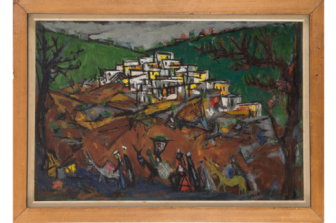
The permanent exhibition showcases masterpieces from the Haifa Museum of Art's collection, which encompasses over 8,000 works, charting major trends in the history of local art. It spans works from the late 19th century to the present, where face and topography are mutually reflected, indicating affinities between the furrows of plowed earth and furrowed faces, between sun-scorched soil and tanned skin, between cracked asphalt and wounded flesh.
Saturday, 02.01.27
THE COLOR: PURPLE | Discovering Tel Shikmona and the Secrets of Purple
New exhibition
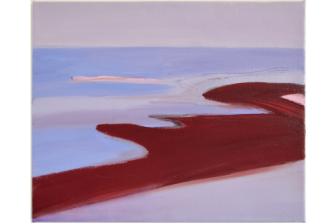
The main focal point of spring 2026 exhibition clusteris the archaeological site at Tel Shikmona (Tell es-samak, “The Fish Mound”) and the production of purple dye from sea snails—an activity that took place at the site in ancient times. The cluster includes a new archaeological-historical exhibition dedicated to the production of purple (argaman and tekhelet), as well as art exhibitions responding to the remarkable presence of the archaeological tell within the urban setting of Haifa and to the traces of lost time embodied in it. These join the “Fish Mound” exhibition, which exhibits local finds attesting to a remarkably long duration of continuous settlement at Tel Shikmona—from the late Bronze Age to the late Byzantine era.
Friday, 30.04.27
The Secrets of Purple | Time capsule
New exhibition
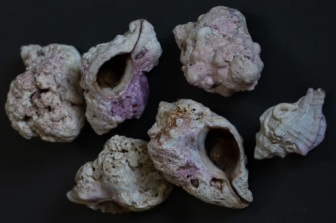
A fascinating journey in the footsteps of antiquity's "purple gold": from the professional secrets of extracting purple dye from sea snails, to the royal textiles of emperors and priests. Inside this time capsule, we uncover the "Haifa connection" through the findings of Tel Shikmona, which served as an industrial-scale purple dye production center throughout the Iron Age. We will become acquainted with the story of the Phoenicians, the "Purple People," and discover how a tiny snail became a symbol of wealth, status, and sanctity across the ancient world.
Maya Gratzfeld: “So small, so humble, I float in the sea” | A homage to Argaman production in Tel Shikmona
New exhibition
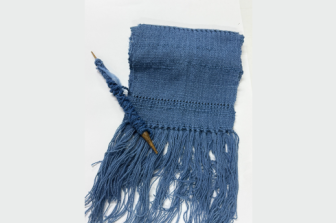
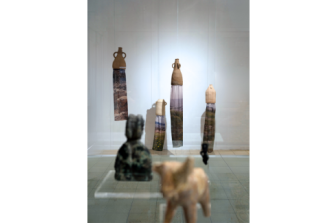
Maya Gratzfeld’s exhibition explores the long-lost traces of purple dye industry in Tel Shikmona. Production of the most valuable dye in the ancient world was the secret to the prosperity of this coastal site, located on the coast of Haifa, only a short distance away from the museum. Purple (Argaman) dye, produced from the bodies of sea snails through a complex chemical process, turned the place into a significant economic and commercial center in ancient times.
Friday, 30.04.27
Please contact us and we will contact you as soon as possible